All workCase study 02 / 05
AI platform · Engineering teams · 2026
Agentic AI that engineers trust
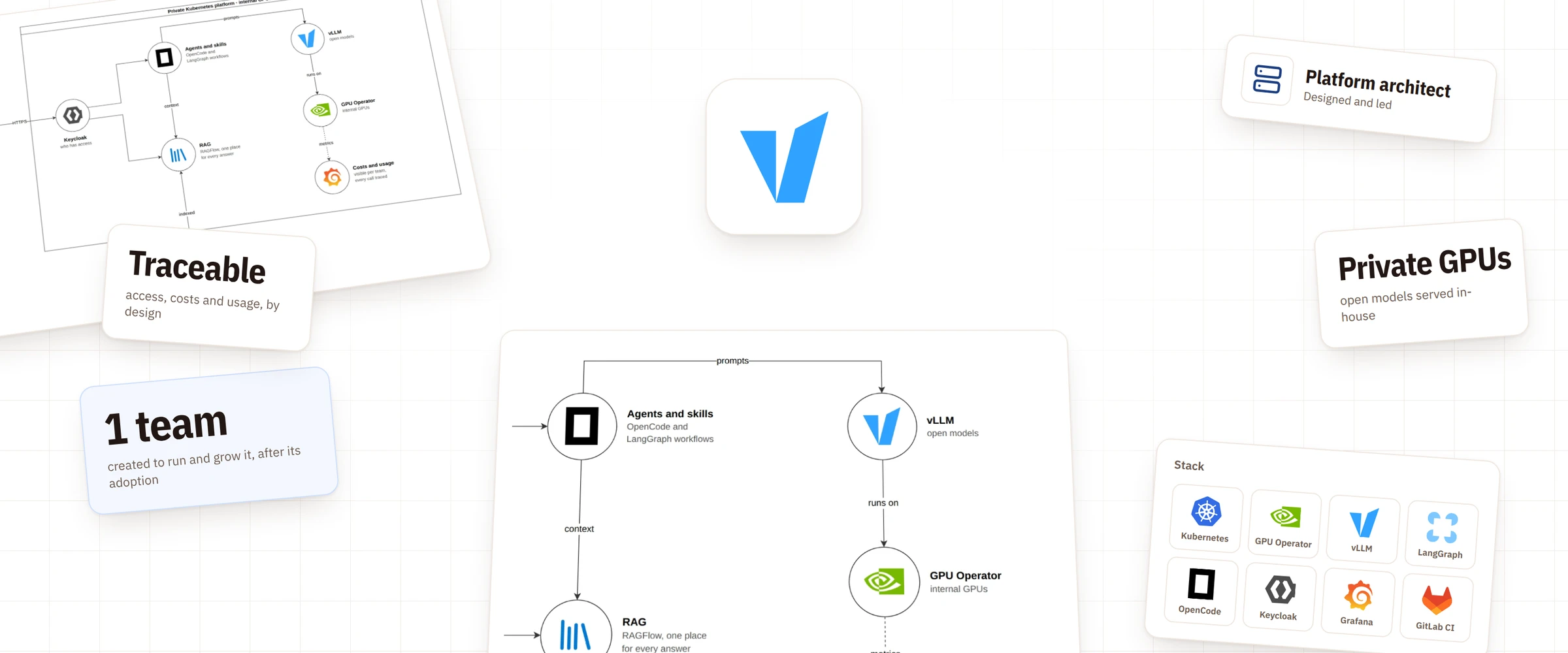
Engineers lost weeks to repetitive tasks and scattered documentation. I designed and led an agentic AI platform on private GPUs, with the guardrails that made people trust it. Its adoption led to a dedicated team.
- Role
- Platform architect and project lead
- Built for
- The engineering teams
- Duration
- 2026
- Stack
- Kubernetes · NVIDIA GPU Operator · vLLM
1 team
created to run and grow it, after its adoption
Private GPUs
open models served in-house, no data sent to a third-party API
Traceable
access, costs and usage, by design
01 · The need
Engineering teams lost time on repetitive, low-value tasks, some of which dragged on for months, and the information they needed was scattered across many tools. AI could take that work off their hands, but only if they trusted it.
02 · Constraints and decision
- Constraints
- Data · nothing leaves the company; models run on internal GPUs.
- Trust · engineers use agents they can control: who has access, what it costs, what it did.
- Fit · the platform plugs into the tools teams already use.
- Options
- A hosted AI assistant · quick to start, but data leaves the company and costs stay opaque.
- A private agentic platform · more to build, but data, costs and usage stay under control.
- Decision
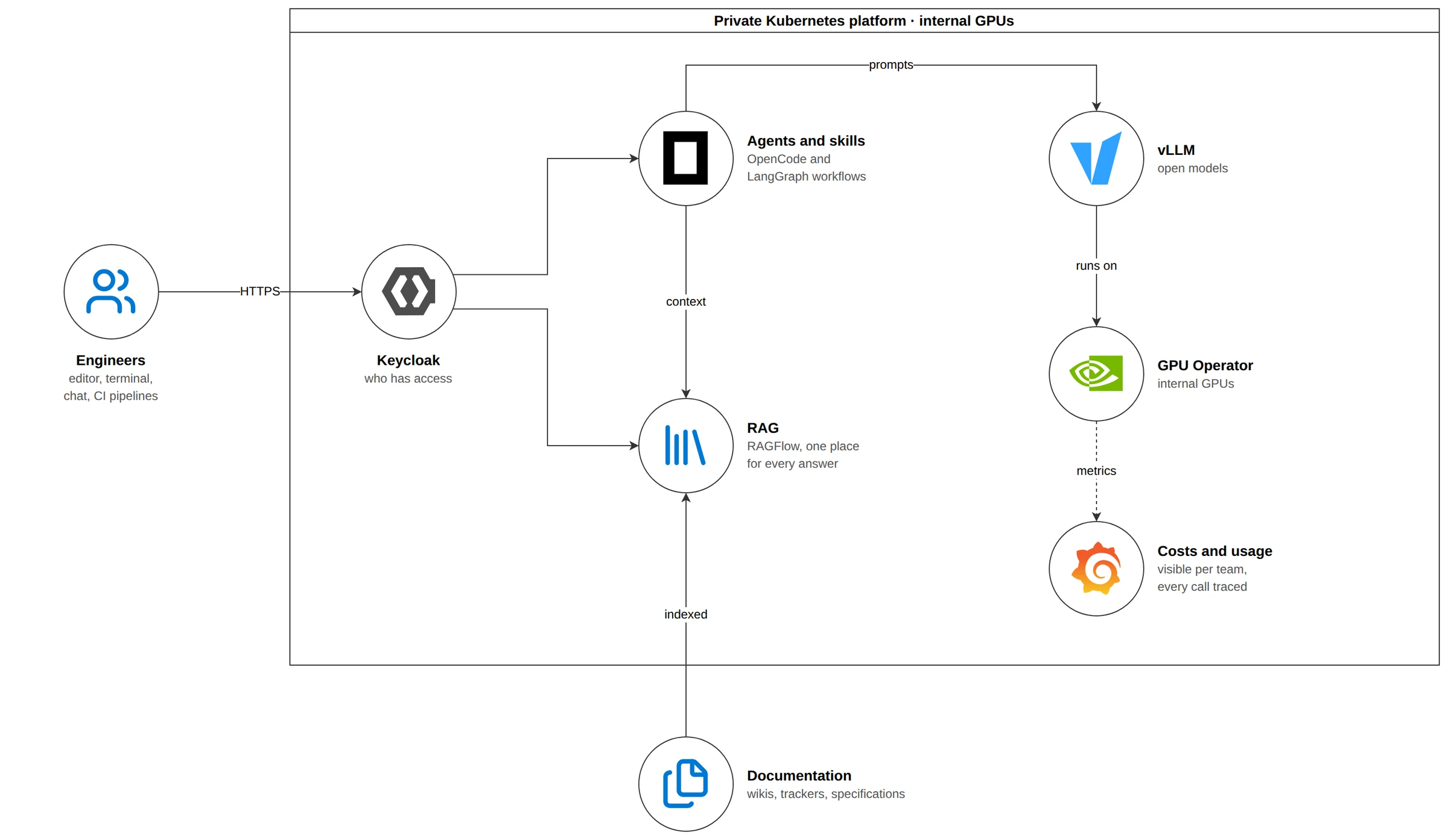
- Models · open models served with vLLM on Kubernetes, on internal GPUs with the NVIDIA GPU Operator.
- Agents · reusable skills and agent workflows with OpenCode and LangGraph, for precise engineering tasks.
- Knowledge · a RAG with RAGFlow over the scattered documentation, so answers come from one place.
- Trust · access control with Keycloak, visible costs, traceable usage and a few simple rules.
03 · Architecture
The platform
 Kubernetes
 NVIDIA GPU Operator
 vLLM
 LangGraph
 OpenCode
- RAGFlow
 Keycloak
04 · Result
- Used daily by several engineering teams.
- Its adoption led to a dedicated team to run and grow the platform.
- Repetitive tasks handed to agents, and answers found in one place instead of many.
05 · What I learned
- The hard part of agentic AI is not the model, it is trust: people adopt agents they can control, measure and explain.
Next case study
Alfa-Safety · 2024 – 2025Collecting and analyzing 2 TB of logs a week